Hey, I think I saw Barack go down there…
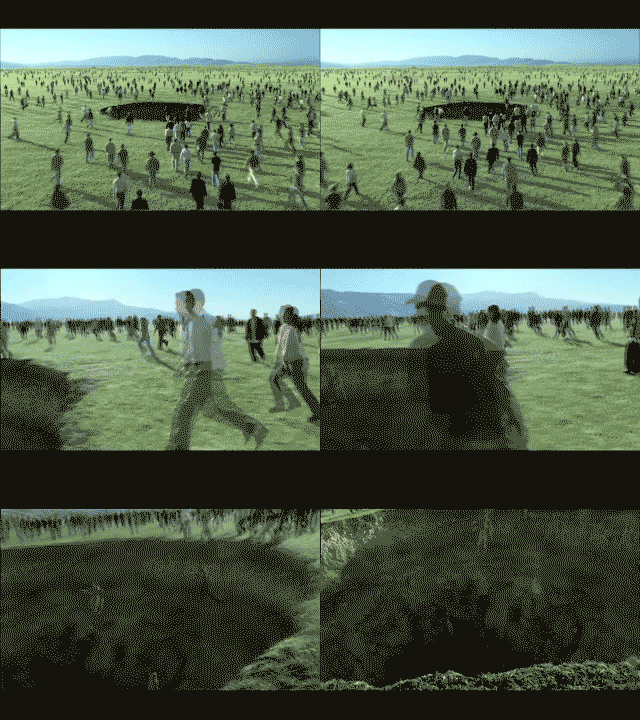

Hey, I think I saw Barack go down there…
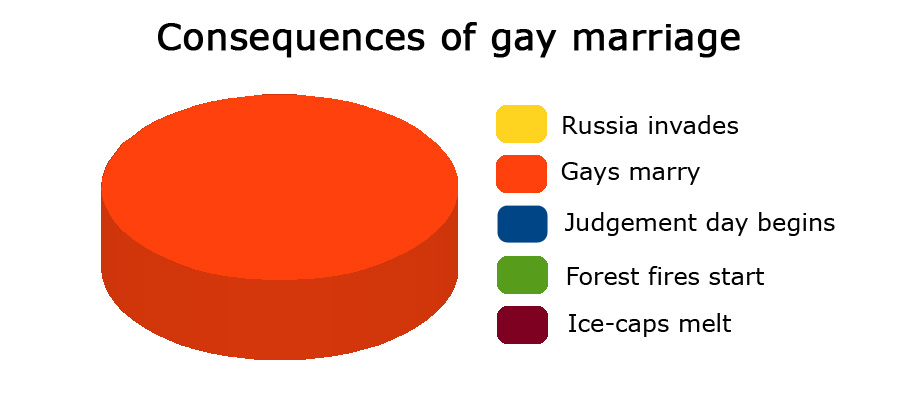
Gay marriage – whatever.
It is not really relevant what the president thinks about it. If this is your litmus test for who you choose to vote for for president. You are an idiot. (It you are gay you might not be an idiot, probably a fool.) Unless he proposes amending the constitution or petitioning the Supreme court to make it a guaranteed civil right, It is up to the states to decide. The president really shouldn't be involved in this issue. Our current POTUS has a lot of much more important things he is not doing well. He needs to work on some of them.
Gay marriage will become a reality in a generation. We just need to let nature take it;'s course, not get the federal government involved on this one.
I couldn't care less what homosexuals do, as long as they are not in my face with it . I don't think it is a choice. The same goes for Heterosexuals. But it seems like society shouldn't glorify homosexuality as somehow more noble or courageous than heterosexuality. How is it so noble to be gay if it is not a choice? I guess I don't get that part either.
The Founding Fathers on "Wealth Re-Distribution" and some closely related subjects.
People always talk about the intent of the framers of The Constitution. From the words that follow, it seems clear that what is happening today is definitely outside of those carefully considered bounds. And therefore, this Republic is probably doomed to dissolution either by atrophy or insurrection. Unless something changes. Ben Franklin probably sums it up best.
“When the people find that they can vote themselves money, that will herald the end of the republic.” — Benjamin Franklin
“A wise and frugal government… shall restrain men from injuring one another, shall leave them otherwise free to regulate their own pursuits of industry and improvement, and shall not take from the mouth of labor the bread it has earned. This is the sum of good government.” — Thomas Jefferson, First Inaugural Address, March 4, 1801
“I cannot undertake to lay my finger on that article of the Constitution which granted a right to Congress of expending, on objects of benevolence, the money of their constituents.” — James Madison, 4 Annals of Congress 179, 1794
“To take from one, because it is thought his own industry and that of his fathers has acquired too much, in order to spare to others, who, or whose fathers, have not exercised equal industry and skill, is to violate arbitrarily the first principle of association, the guarantee to everyone the free exercise of his industry and the fruits acquired by it.” — Thomas Jefferson, letter to Joseph Milligan, April 6, 1816
“I predict future happiness for Americans if they can prevent the government from wasting the labors of the people under the pretense of taking care of them.” — Thomas Jefferson
“[T]he government of the United States is a definite government, confined to specified objects. It is not like the state governments, whose powers are more general. Charity is no part of the legislative duty of the government.” — James Madison
“Wherever the real power in a Government lies, there is the danger of oppression.” — James Madison
“If Congress can do whatever in their discretion can be done by money, and will promote the general welfare, the government is no longer a limited one possessing enumerated powers, but an indefinite one subject to particular exceptions.” James Madison, “Letter to Edmund Pendleton,” — James Madison, January 21, 1792, in The Papers of James Madison, vol. 14, Robert A Rutland et. al., ed (Charlottesvile: University Press of Virginia, 1984).
"An elective despotism was not the government we fought for; but one in which the powers of government should be so divided and balanced among the several bodies of magistracy as that no one could transcend their legal limits without being effectually checked and restrained by the others.” — James Madison, Federalist No. 58, February 20, 1788
“There are more instances of the abridgment of the freedom of the people by gradual and silent encroachments of those in power than by violent and sudden usurpations.” — James Madison, speech to the Virginia Ratifying Convention, June 16, 1788
“I am for doing good to the poor, but I differ in opinion of the means. I think the best way of doing good to the poor, is not making them easy in poverty, but leading or driving them out of it.” — Benjamin Franklin
“They that can give up essential liberty to obtain a little temporary safety, deserve neither liberty or safety.” — Benjamin Franklin
“The Constitution only gives people the right to pursue happiness. You have to catch it yourself.” — Benjamin Franklin
“Democracy never lasts long. It soon wastes, exhausts and murders itself. There was never a democracy that did not commit suicide.” — John Adams
“But a Constitution of Government once changed from Freedom, can never be restored. Liberty, once lost, is lost forever.” — John Adams
The 4 principle reasons why a federal government was formed
"(1) The common defense (national security);
(2) the preservation of public peace, as well against internal convulsions as external attacks;
(3) the regulation of commerce with other nations and between states;
(4) the superintendence of our intercourse, political and commercial, with foreign countries." – Alexander Hamilton, Federalist Paper No.23
Above in more detail: "The powers delegated by the proposed Constitution to the federal government are few and defined. Those which are to remain in the State governments are numerous and indefinite. The former will be exercised principally on external objects, as war, peace, negotiation and foreign commerce. … The powers reserved to the several States will extend to all the objects which in the ordinary course of affairs, concern the lives and liberties, and properties of the people, and the internal order, improvement and prosperity of the State." – James Madison, Federalist Paper No. 25
"I place economy among the first and most important of republic virtues, and public debt as the greatest of the dangers to be feared." -Thomas Jefferson to William Plumer, 1816
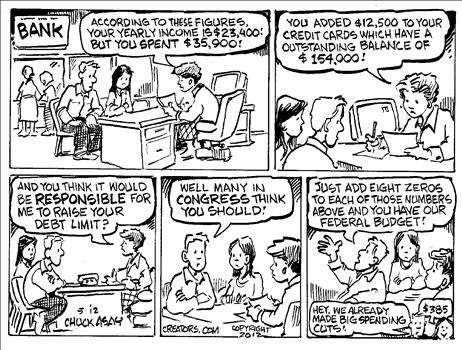
Good Video to illustrate the idiocy of what is being touted as spending cuts
And not only that but it might even be a "Draconian Spending Cut"!
Also not that a "spending cut", as it generally defined by legislators, is more likely to be, simply, a smaller increase in spending than last year. (also probably draconian.)

While it MAY be legitimate to argue that there is some money being spent by the military that is wasteful or perhaps not well managed. It is profoundly ironic that anyone would suggest that ANY new spending initiative should be "funded" by cutting defense spending.
Of course this is because, in reality, National Defense is just about the only thing that the Federal Government should be involved with in a big way. The lions share of the Federal Budget SHOULD be defense, not "safety nets".
Unless this sinks in, the U.S.A. fiscal problems will not diminish. Some government safety nets are very appropriate, but many of our safety nets have become multi-generational wealth redistribution programs (entitlements). Nobody really seems to understand that this means major, serious re-evaluation is needed. Welfare reform is NOT synonymous with elimination of legitimate safety nets. It means eliminating waste, fraud and abuse. But most important, it means eliminating the welfare mentality. Making it so that welfare is an intermediate step to personal responsibility and the good old fashioned work ethic. It is also very confusing that we need special legislation to look into eliminating waste, fraud and abuse in these bloated programs.
"Politics is a strife of interests masquerading as a contest of principles." — Ambrose Bierce
Rev. Wright is an unapologetic racist and proponent of black liberation theology. He is also the "spiritual mentor" of Barack Obama. Why is it that nobody see this as an issue?